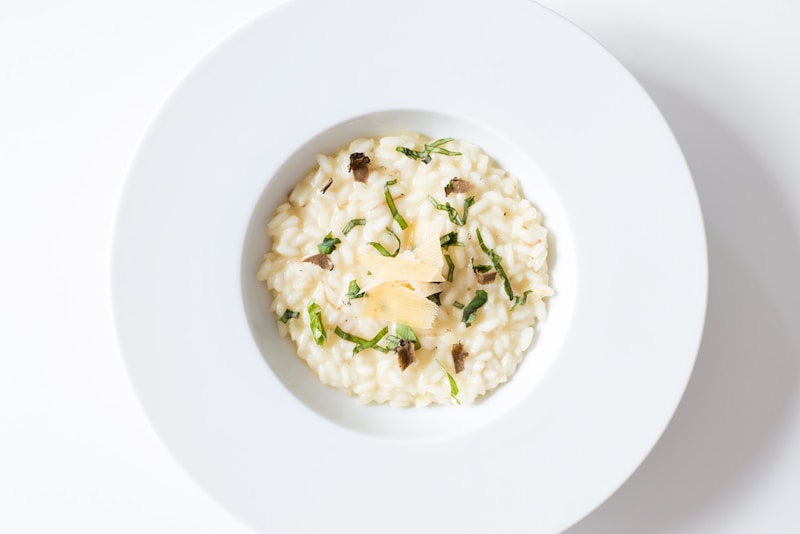
In Milan, there's a saying: "Il risotto non aspetta nessuno"—risotto waits for no one. It's a dish that demands your full attention from the first toast of rice to the final mantecatura. And if you dare suggest that a robot could make it? Prepare for a debate that could last longer than a traditional Sunday lunch.
The accidental invention
Risotto wasn't invented in some grand kitchen by a celebrated chef. Legend has it that in 1574, a young apprentice working on the Duomo di Milano's stained glass windows made a mistake. He was known for adding saffron to his paints for a richer gold color. One day—perhaps distracted, perhaps mischievous—he added saffron to his rice at a wedding banquet.
The guests went silent. Then they asked for more.
Risotto alla Milanese was born from what should have been a disaster. And perhaps that's fitting, because making risotto has always been about dancing on the edge of disaster.
The sacred technique
Ask ten Italian nonnas how to make risotto, and you'll get ten different answers delivered with absolute certainty. But certain principles are non-negotiable:
The soffritto must be gentle. Onions should become translucent, never browned. This isn't a stir-fry; it's a meditation.
The tostatura—toasting the rice—is where amateurs reveal themselves. Each grain must be coated in fat and heated until the edges become translucent while the center stays opaque. This creates the foundation for the al dente texture. Rush this, and no amount of stirring will save you.
The sfumatura with wine is a moment of drama. The cold wine hits the hot rice, and steam rises like a curtain lifting on the second act. The alcohol must burn off completely—any residual wine taste is considered a failure.
The brodo is added one ladle at a time. Always hot, never cold. The temperature shock of cold broth would be like serving a guest room-temperature espresso: technically functional, spiritually unacceptable.
The stirring controversy
Here's where it gets heated. Traditional wisdom demands constant stirring—the ritualistic movement that releases starch and creates risotto's signature creaminess. It's also what makes risotto a dish that chains you to the stove for 18 to 20 minutes of undivided attention.
But modern food scientists like Harold McGee have questioned this orthodoxy. Experiments show that stirring matters most at the beginning and end—the middle can tolerate some neglect. Italian traditionalists consider this heresy. The stirring, they argue, isn't just technique; it's an act of care. It's what separates a cook from someone who merely heats food.
The all'onda test
The ultimate test of a risotto is the "all'onda"—the wave. Tap the plate, and the risotto should flow like a gentle wave, neither too stiff nor too liquid. It should settle slowly, reluctantly.
Too thick? You've created rice cake. Too liquid? That's rice soup.
The all'onda exists in that perfect moment between states, which is why Italians say risotto waits for no one. The dish is ready when it's ready, and you serve it immediately or not at all.
The mantecatura: the final act
Just before serving, the risotto comes off the heat. Cold butter and grated Parmigiano-Reggiano are vigorously stirred in—this is the mantecatura, the step that gives risotto its luxurious sheen and final creaminess.
The butter must be cold so it emulsifies rather than simply melting. The cheese must be real Parmigiano-Reggiano, aged at least 24 months. Anything less, and you're not making risotto—you're making rice with cheese.
Why the robot changes everything (and nothing)
Your cooking robot can maintain perfect temperature, stir with mechanical consistency, and time each phase with precision no human can match. Traditionalists will tell you this misses the point.
But here's what they might not admit: the robot frees you to focus on what actually matters. The quality of your rice. The depth of your brodo. The freshness of your saffron. The age of your Parmigiano.
A robot handles the mechanics. The soul of the dish? That's still entirely up to you.
What will your risotto say about you?